Native Speaker Sentences (from the WAXAL dataset) in Baoulé
Play 509 fill-in-the-blank cloze sentences and get fluent faster.
About this Collection
Description
509 sentences read aloud by native Baoulé speakers, from WAXAL, a speech dataset by Google Research with University of Ghana (https://huggingface.co/datasets/google/WaxalNLP), licensed CC BY 4.0 (https://creativecommons.org/licenses/by/4.0/). Clozemaster selected the sentences, corrected capitalisation, punctuation and diacritics, chose the missing words, added machine-translated English, which may contain mistakes, and converted the recordings to MP3. Please report any mistakes you find.
All 509 sentences
These sentences come from WAXAL, by Google Research with University of Ghana, licensed CC BY 4.0. Clozemaster selected the sentences, corrected capitalisation, punctuation and diacritics, chose the missing words, added machine-translated English, which may contain mistakes, and converted the recordings to MP3.
-
Tabaski ti blɛ cinnjin kpa man gnanmien flɛ fue me nvle’n nunfuɛ be diman juman jin sɔ nu.Tabaski is a very important time for Muslims; people in the country do not work on that day.
-
OMS (Organisation mondiale de la santé) di junman cinnjin kpa mɛn wunmuan’n nun tukpacɛ’n i siesielɛ nun.The WHO does very important work in tackling disease throughout the world.
-
Ti nyanlɛ ciɛn mɔ be di i utu'n i le n'so su’n, ɔ ti cɛn cinnjin kpa.Independence Day, which is celebrated on the seventh of August, is a very important day.
-
Nnɛn be nu, jra niɛn klua nyandi ɔ; be nu kansiɛn ku su yɛ lɛ ayicle.Among the animals, the lion is the one that outruns them all; the very last among them is the tortoise.
-
Tahi bo, ti bo kun mon awa kpɛ kɛ nan man be di fiɛ lɔ. I klun lɔ, be nyan nnɛn wafawafa kaka.The Taï forest is a forest that the government has ruled must not be farmed. Inside it, you can find a great many kinds of animals.
-
Nzi rivɛ loj, wo Buakɛ lika liɛ nnon, Brobo asa liɛ su lɔ. Lɔ nzi ngbamdan si'n lɔ, yɔ be klua wun nnɛn wafawafa kaka.N'Zi River Lodge is in the Bouaké area, over towards Brobo. There, behind the N'Zi river, you can see a great many kinds of animals.
-
Hufue Buanyi yɛ ti Cɔt d'Ivua nvle i sun klɔ kpɛn klikli nion.Houphouët-Boigny was the first president of Côte d'Ivoire.
-
Alo'n nu ba klikli ɔ sie n'gluɛlɛ kpa.The first child in the family is very wise.
-
UNICEF uka bakanngan nga alɛ’n tɔli be su’n.UNICEF helps children who have been struck by war.
-
Anglo ba kpadja m'sue i isu lɛ.The moon is shining on the water there.
-
Kɔnguɛ nu, anglo ne ta yɛ nika ne yo djuwa yɛ nika ne yo diii, gnanmiɛn ne sene kɔkun nika ne yo tuonn.At night the moon is shining, it is bright and calm, the sky is clear and everything is still.
-
Djuakle nɔ ti anglo me nun tika kpa non.February is the shortest of the months.
-
Masi yɛ ɔyi afuɛ nun anglo n'san sun niɔn.March is the third month of the year.
-
N'glo ti fla be anglo, i nu yɛ be manman be ɔ.February is the month of lovers; that is when they are celebrated.
-
Anglo su jaso.The moon is rising.
-
Via ni anglo ba be a ya nu.The sun and the moon have come together.
-
Abɛnglu klɔ kpɛn nga be sua tɛkɛ i ase ananya anglo nga nu, ti Abɛnglu klɔ kpɛn i abla'n ni nnyon su.The chief of Abengourou who was enthroned this month is the twenty-second chief of Abengourou.
-
Asɔnufuɛ be annya, ti anglo ngɔ balɔ i le blu ni nsan su.The church members' meeting is on the thirteenth of next month.
-
Ndɛ via bo dan kpa.Today the sun is shining very strongly.
-
Kɔ fɛi nglɛnmunu mɔ fa ju ndɔsua nu, lika waa do kpa liɛ su. Djuakle anglo nga nu, kɛ via le bo sɔ titi ɔ.From the morning right through to the evening, it will be very hot. In this month of February, that is how the sun always shines.
-
Kɛ Robert Guéï fali famiɛn dilɛ’n afuɛ 1999 nun’n, ɔ fali Côte d’Ivoire i nrun politiki nun kɛ be fuanni Bɛdiɛ.When Robert Guéï took power in 1999, he took the lead in Côte d'Ivoire's politics as Bédié was driven out.
-
Amangno nan su n'ma.The mango tree has borne fruit.
-
Gehi Robɛ wouli alɛ blɛ nu.Robert Guéï died during the war.
-
Ɛjua dan ni fite.A big sun is coming out.
-
Suklu m'ma ma fite yɛ be m kɔ alo.The schoolchildren have come out and are going home.
-
Sika ɔklɛ nan fite kpɛlɛ i ti afiɛn lɔ.Gold has appeared right on top of the rock.
-
Gnamiɛn ne tanni glinmu lele e kla fite e soi menu.It has been raining since the morning, so much that we cannot go out of our houses.
-
Kuasi I suklu ma ba fite.Kouassi's pupils have come out.
-
Kofi I aluɛnba wa fite i klu.Koffi's heart has come out of his chest.
-
Klɔ muan wa fite poku tolɛ lika lɔ.The whole village has turned out at the football pitch.
-
Via wa fite un'glo.The sun has come out up above.
-
Soi n'gna diɛ ɔ ti klanman, dan yɛ flɛɛ flɛɛ me o bo si yɛ.As for this house, it is beautiful and big, and there are flowers behind it.
-
Mali lɔfuɛ me si kɛ be nzuɛn’n ti kpa, yɛ Saheli lɔ lika’m me ti klanman kpa.Malians are known for their fine culture, and the landscapes of the Sahel are very beautiful.
-
Aya gua i fie’n nun flɛri’m be su nzue, i flɛri’m ba yo klanman kpa.Aya waters the flowers in her garden; her flowers have become very beautiful.
-
Gine lɔ’n, Nimba oka’n ti lika klanman kpa kun mɔ be kwla kɔ nian ɔn.In Guinea, Mount Nimba is a very beautiful place that people can go and see.
-
Yao ɔ wo i kpangɔ klanman su.Yao is on his beautiful bicycle.
-
Flɛli klanman kun wa nyii.A beautiful flower has grown.
-
Wia ɔ bo klanman kpa n'gluin mu.The sun shines very beautifully in the mornings.
-
Nyanmiɛn ble wa fite klanman kpa.The blue sky has come out looking very beautiful.
-
Asunu fuɛ ɔn kɔ asɔnu soi nu lɔ ko srɛ gnanmiɛn.The Christian goes to the church to pray to God.
-
Kɛ Ramadan anglo sanwun’n wie’n, Ivoiri lɔ Mizilman’m be srɛ Ɲanmiɛn.When the holy month of Ramadan ends, Muslims in Côte d'Ivoire pray to God.
-
Be kan kɛ jin gna e yo jua jin afin ɛjua ne bo lele nika ne san flɔlɔlɔlɔ.They say that today will be a sunny day, because the sun will shine until the sky is completely clear.
-
Be seli kɛ djin gna ɔ a yo dowa djin, afin ɛjua ne bo m'gliemon letetete nika e san.They said that today would be a hot day, because the sun will shine from the morning all the way until nightfall.
-
Be fali Grand-Bassam be sieli UNESCO i mɛn wunmuan’n nun lika’m be nun.Grand-Bassam has been placed among UNESCO's world heritage sites.
-
N’vufu ti laa aliɛ kun mɔ be fa banana mɔ be kpɛli’n be yo ɔ.Foufou is a traditional dish made from plantains that have been cut up.
-
Grand-Bassam ti laa blɔfuɛ be su be klɔ dan kun mɔ UNESCO fali mɛn’n nun ninnge’m be su ndɛ’n sieli i lika kun’n.Grand-Bassam is an old colonial town that UNESCO has placed on its list of world heritage.
-
Mali lɔfuɛ’m be si i laa klɔ kɛ Timbukto sa.The people of Mali are known for ancient towns such as Timbuktu.
-
Kofie anglo nu yɛ be kpa fie lika be su ɔ.It is in the month of April that people clear their fields.
-
Boli n'ji fie nu, ɔ su di ijre.A goat is standing in the field, eating grass.
-
ONU yɛ ɔ siesie sran me ukalɛ junman’n nika nga ɛlɛ’n tɔ lɔ’me nun non.It is the UN that organises aid work for people in places where war has broken out.
-
Amun siesie aɲia kun ya cɛn.You are arranging a meeting for Friday.
-
Poyo nan blo.The avocado is ripening.
-
Ablɛlɛ ti blo wa.The pineapple is ripe.
-
Kɔmiɛn ti Anyi be nzɔliɛ like.The Komian is an emblem of the Agni people.
-
Wan ɛ ɔ yoli Kɔdivoiri man sie sie fuɛ n'gnon su non? Kɔdivoiri be man sie sie ngnon su nɛ Konan Bɛdiɛ.Who was the second president of Côte d'Ivoire? The second president of Côte d'Ivoire is Konan Bédié.
-
Amun bla min awlo lɔ Fue cɛn naan y’a kan e junman’n i ndɛ.Come to my house on Saturday so that we can talk about our work.
-
Gbanflin I ja m'kpin.The young man's legs are sturdy.
-
Kofi su tu i ja si kpaco.Kofi is sprinting at full speed.
-
Jra fɛ li i ja bui fitili balon.The lion kicked the ball with its heel.
-
Koniɛn difuɛ nan kla kun man bua.The hunter is not able to kill a sheep.
-
Bua ablaɔn ni akɔ ablamɔjuɛ ba u.Twenty sheep and eighty chickens have died.
-
Bua be wo be kuku nlɔ.The sheep are in their pen.
-
Be yo sukuya ni klɔ nnɛn kɛ, nanni sa, bua sa, ɔni boli sa.Choukouya is made with domestic animals such as beef, mutton and goat.
-
Tabaski nu, jra'm be fa bua mu be yi sraka.At Tabaski, the Dioula take sheep and offer them as a sacrifice.
-
Eid-el-Kebir, annzɛ Tabaski cɛn dilɛ’n, be fa bua kun be yi tɛ.At Eid al-Kebir, or Tabaski, a sheep is sacrificed.
-
Jɔlɛ jin, n'kɔ fluwa siewlɛ lɔ n'ko suan fluwa.On Tuesday I go to the library to study.
-
Nyamiɛn nuan ijɔfuɛ, be suan nyamiɛn flua su like be suklu be nu.Preachers study the holy book at their schools.
-
Abɛbɛ n'san be su suan tulɛ.Three butterflies are learning to fly.
-
Aya su suan fluwa.Aya is studying.
-
Mi suan fluwa ciɛn klua.I study every day.
-
Klɔ n'gna su fuɛ me luaman tralɛ.The people of this village do not wear clothes.
-
Amun klo tralɛ ufue mun?Do you like white clothes?
-
Akisi fa li tralɛ ufuɛ fuɛ?Did Akissi take the white dress?
-
Kofi i tralɛ n'san n'gabɔ ɔ toli lemɔcuɛ n'san n'ga nu ba yo fiɛn.The three pieces of clothing that Koffi bought these past three weeks have got dirty.
-
Imamu be yɛ be ti nyamiɛn flɛfuɛ be su kpɛn mu ɔ.Imams are the ones who are the leaders of the Muslims.
-
N'nan me nun kpene n'gbenegbe nan u.Among the animals, the oldest one has died.
-
Sran ble n'nyon be ni blɔfuɛ kun be su nanti.Two black people and one white person are walking.
-
Aofuɛn la sroloooo.The guest is lying perfectly still.
-
Kosan: Cɔt divua jue tofuɛ beni yɛ to jue regae nu nion? I su tɛlɛ: Sran ngɔ to jue i regae nu yɛlɛ Alfa Blondi.Question: Which Ivorian singer sings reggae? Answer: The person who sings reggae is Alpha Blondy.
-
Katajua kun djilɛ kukun i bue ti ɔklɛ i bue ti ufue, i bue ti ble.An umbrella is standing there; part of it is red, part of it is white and part of it is black.
-
Aluɛnba ufue ɔ wo sran i klun.A white heart is inside the person.
-
Titi’n, ble nin ufue be yo like klanman kpa kun.Black and white always make something very beautiful together.
-
Alua su i fuɛ su be su kɔ fiesu.The dog is following its owner; they are going to the field.
-
Aba ɔ ni alua be su wandi kɔ blo.Aba and the dog are running off to the bush.
-
Suclu cle fuɛ bla nga be flɛ i Amlan, su klɛ ndɛ’n tablo’n su.The woman teacher called Amlan is writing the lesson on the blackboard.
-
Mɛtri Kofi i sukluma mu be su klɛ flua.Teacher Koffi's pupils are writing.
-
Be wuli Kuajo i jɔlɛ cɛn.Kouadio was born on a Tuesday.
-
Be wuli Akisi i Angbɔ anglo nu.Akissi was born in the month of January.
-
Be wuli Ajua jɔlɛ ciɛn.Adjoua was born on a Tuesday.
-
Fɔkɔ atɛ yolɛ’n nin Côte d’Ivoire nin Mali be sika ndɛ’n be kɔ likawlɛ kpa, ɔ maan be afiɛn’n w’a yo kpa laa.The cotton trade and the economies of Côte d'Ivoire and Mali are closely linked, so relations between them have long been good.
-
Abijan lɔ akpɔ’m be su aata difuɛ’m be yo garba atɛ.On the streets of Abidjan, traders sell garba.
-
Planɛti asiɛ I su ɛ e o kɛ n'gna sa.It is on planet Earth that we are living right now.
-
Wia su kpaja klikli kpa asiɛ su.The sun is shining very brightly on the earth.
-
Burkina Faso lɔ asiɛ nga be ti kpa’n, be fa waka mma nin ninnge nga be ti nɲa’n be gua Ivoiri lɔ gua’m be su.From the fertile lands of Burkina Faso, fruit and fresh produce are sent to the markets of Côte d'Ivoire.
-
Fa kloya nsiɛn ngɔ wo tabli su fa jɔjɔsu.Take the six glasses that are on the table and stack them up.
-
Kisie cɛn’n, n bo le mɔcuɛ’n i bo nin wunmiɛn.On Monday I start the week full of energy.
-
Cocody ɔ ti Abidjan apkasua kun mon o clɔ i afien.Cocody is a district of Abidjan that lies in the middle of the city.
-
Buake wo Cote d'Ivoire nvle i afien, be nga be liɛlɛ clɔ i bo yɛ lɛ Baule mun.Bouaké is in the middle of Côte d'Ivoire; the people the town belongs to are the Baoulé.
-
Kuassi a lua i bii m'ssan su.Kouassi has scored his third goal.
-
Abedi a lua e bii n'gnon su.Abedi has scored our second goal.
-
Kuaku ni I ma me di n'gua.Kouakou and his children are playing.
-
Zɔgɔda me gan n'gua.The butterflies are playing.
-
Waka ɔ jin nanni I wulɛ koko.The tree is standing close to the cow.
-
Ahu ma ton aliɛ.Ahou is cooking food.
-
Akissi'n ton gbɔlu tro ni lokpa aliɛ.Akissi is cooking okra sauce and lokpa.
-
Pɔmu I bue kun a saki.One side of the apple has gone bad.
-
Pɔmu nan saki i tiɛ kaka me o nun non.The apple has gone bad because there are worms in it.
-
Sika ɔkluɛyilɛ saki asiɛ.Gold mining ruins the land.
-
Klɔ’n i su lɔ ninnge’m be siesielɛ nin aata dilɛ junman’m be dan lika be o lika Plateau lɔ.Most of the city's administration and business activity is in Plateau.
-
Nika ne yo ɛrɛ kpa andɛ kɛ aliɛ e a djin lɛ.It is very cold today, as day is breaking.
-
Andɛ mɛri I wan be yɛ I alo lɔ, nan be kɔ kan ngua.Today the mayor says they should meet at his house, so that they can go and have a chat.
-
Andɛ ti mlan ciɛn.Today is Wednesday.
-
Nanni ni didi.The cow is grazing.
-
Glɛinmon nun jua ni fite kɔ e sɔ ni nanni ji lɛ.In the morning the sun is coming up, and a cow is standing there.
-
Amandu su nanni be su.Amadou is looking after the cattle.
-
Nanni be su luan luan klɔ nu.Cows are wandering about in the village.
-
Sakasu lɔ yɛ Abla Poku kɔ tranliɔ kɛ ɔ fini Ganan bali.It was at Sakassou that Abla Pokou went to settle when she came from Ghana.
-
Bua ba'n su kundɛ i manmi.The lamb is looking for its mother.
-
N'dɛ tchinba liɛ, lika wa do yɛ ɔ yɔ degre celsis n'ti ablanan.Today during the day it will be hot, and it will be forty degrees Celsius.
-
Man oka’m be su lɔ’n, Aminata klɛli jue kun.In the mountains of Man, Aminata wrote a song.
-
N kunndɛ kɛ n kɔ Ghana lɔ naan n ko wun i jenvie nuan lika klanman’m be luɛ.I want to go to Ghana to see its beautiful beaches.
-
Oka nɛ ɔ yo mɔ ɛrɛ ba non.It is the mountain that makes the cold come.
-
Nimba oka’n ti oka kun mɔ be nin Gine nin Libɛri be o nun’n.Mount Nimba is a mountain that they share with Guinea and Liberia.
-
Mont Nimba yɔti Cote d'Ivoire oka n'gloglo nion.Mount Nimba is the highest mountain in Côte d'Ivoire.
-
Kilimanjaro yɛ ɔ ti sran ble mɛn’n nun oka ng’ɔ ti nglonglo kpa’n niɔn, i nglonglo’n ju mɛtri 5895.Kilimanjaro is the highest mountain in Africa; its height reaches 5,895 metres.
-
Nzueba ba wo oka nnun be afiɛn.The stream lies among five mountains.
-
N'sue ba su son'gi si'n oka i bo.The river is flowing along at the foot of the mountain.
-
Baka ti desɛti kun mɔ be fa able sanmlɛn mɔ w’a ɲin’n be yo ɔ.Baka is a dessert that is made from ground maize that has ripened.
-
Fenetri me ti tike tike wa yɛ ahunkpan fita lɔ kpa.The windows are wide open and the wind is blowing in nicely.
-
Nzue ni ma tɔ dan, ɔ nin aunkpan m’ɔ fita kekle kpa.It is raining heavily, with a wind that is blowing very hard.
-
Kɔn'guɛbunuɛn nu, awungban waa fita kpa liɛ su, yɛ kɛ waa kpɛ nzue le kpɛnkpɛn, ka nan wa bo tɔ lɛ bo aliɛn'jɛnniɛnsu.In the middle of the night the wind will blow very hard, and there will be flashes of lightning before the rain starts to fall towards daybreak.
-
Alapla wo n'glo, ɔ su kɔ.The aeroplane is up in the air; it is on its way.
-
N'zralama be wo nyanmiɛn nulɔ.The stars are in the sky.
-
Baba wa fu i moto ble'n su.Father has got on his black motorbike.
-
Ciɛn klua mi fu kpangɔ su.Every day I ride a bicycle.
-
Ehotile Kongo, ɔ o nvle i via afiliɛ lɔ lika nun, ɔ mantan Atlantiki jenvie’n i nuan lɔ.The Ehotilé Islands lie in the south-east of the country, close to the shore of the Atlantic Ocean.
-
Flɛli be mantan abɛbɛ be wu kokolɛ.The flowers are right next to the butterflies.
-
Ijre su kpu.The grass is sprouting.
-
Ijre wafu klɔ i afiɛn kpann'gban.A lot of grass has grown in the middle of the village.
-
Bla bie ma ton mankun ɔklɛ tro ni djene.A woman is cooking a red pepper sauce with onion.
-
Manda aliɛ ni aye tro annzɛ wawasu ɔti ivoirien be acloliɛ like pka.Plantain foutou with palm nut sauce or wawasu is what Ivorians love most.
-
Côte d’Ivoire lɔ politiki klɔ dan benin yɛ ɔ o lɔ nɔ? Yamusuklɔ yɛ ɔ ti politiki clɔ dan non.Which is the political capital of Côte d'Ivoire? Yamoussoukro is the political capital.
-
Kuasi ni Kuai be fu li kpangɔ wɔli klɔ nvuɛn su lɔ.Kouassi and Kouahi got on a bicycle and rode to the edge of the village.
-
Akɔ nga ɔ to li sua i sin lɔ wa bobo.The hen that laid her eggs behind the house has hatched them.
-
Akɔ kédjénu ɔ ti Ivoiri lɔ aliɛ dan kpa kun.Chicken kedjenou is a truly great Ivorian dish.
-
Nanni kpanngɔ wa bo je.The horse has neighed.
-
Agbɔ nu be di fɛtri dan.In January there are big celebrations.
-
Fue cɛn kwlaa’n, n nin min janvuɛ mun e kɔ balon bo wa.Every Saturday, my friends and I go to play football.
-
Fue ti kpa kɛ be siesie fitewa janvuɛ be afien annzɛ osufuɛ be afien.Saturday is a good day for arranging outings with friends or with family.
-
Ajua ni'n Amlan mɔ kɛ ɔ fɛ i be bakan nun lele, be ti janvuɛ dan kpa, be bo jesse bo bolɛ anuanzɛ kun.Adjoua and Amlan, who have been very close friends since childhood, started an association together.
-
Eid al-Fitr blɛ nu, awlo bo fuɛ'm be yia be di aliɛ kɛ be kɔ vie nglɛnmu cilɛ anglo kun.At Eid al-Fitr, families gather to eat after finishing a month of daytime fasting.
-
Noɛli cɛn dilɛ’n ti blɛ kun mɔ Klistfuɛ awlobo’m be kwla yia asɔnu lɔ yɛ i kasiɛn aliɛ kpa kun be wun lɛ ɔ.Christmas is a time when Christian families can gather at church and afterwards share a good meal.
-
Kɛ bé dí Paki’n, Klistfuɛ’m be yia be wla kpɛn Zezi Klist i cɛnlɛ’n su.When Easter is celebrated, Christians gather to remember the resurrection of Jesus Christ.
-
Ndɔsua nga arɛ ɔ o nun, ye nzue ni tɔ man.This evening it is cold, and it is not raining.
-
Aya wa dua i tro fie, fie su lɔ.Aya has planted her vegetable plot out at the farm.
-
Aliɛ ng’ɔ klo i kpa’n yɛle akɔ kedjenou m’ɔ nin avie.The food he likes best is chicken kedjenou with rice.
-
Aliɛ dan’n i cinnjinn yɛle avie kin inwa ni druvi’n mon manku o nu kpa.The main thing in the big meal is fried rice with oil and plenty of chilli in it.
-
Sran kun ti bia su lɛ.Someone is sitting on a chair there.
-
Bia be wo nzue I bo.The chairs are under the water.
-
Kɛ Hufue sakali Konan Bɛdiɛ ɔ tranni bia su ɔ.When Houphouët passed away, Konan Bédié took the seat of power.
-
Baba ti bia n'su, ɔ su kann'gan flua.Father is sitting on a chair, reading a book.
-
Sran n'nu be juli sɛsɛ dɔ n'nu ni bue su yɛ be tranli bia n'nu su sɛsɛ.Five people arrived at exactly half past five and sat down on exactly five chairs.
-
Lika wa kpaja fitɛ fitɛ kpa.It has become very bright everywhere.
-
N'zralama'n su kpaja dan kpa.The star is shining very brightly.
-
Ghanna lɔfuɛ’m me si i kpa kɛ sika ɔklɛ atɛ yolɛ’n nin i jenvie nuan lika klanman mu.Ghana is very well known for its gold trade and its beautiful beaches.
-
Angbɔ nun’n, blɛ sunman nun’n, glaci kata oka’m be su.In January, ice often covers the mountains.
-
Catavia kata ba i ti su.The umbrella covers the child's head.
-
Afue I ɔdinatɛ taka tabli su.Affoué's computer is on the table.
-
Jɔlɛ cɛn bla mun ni yasua mun be kɔ fiesu.On Tuesday the women and the men go to the fields.
-
Abɛbɛmu be n'tu si'n kɔ anuman be anya i bo.The butterflies are flying off to where the birds are gathered.
-
ONU (Nations Unies) di junman naan fɔundi, nin alaje, nan mɛn wunmuan’n nun wa yo kpa.The UN works for peace and security, so that things go well throughout the world.
-
Nvle’m be anuannzɛ’n (ONU) di junman naan mɛn wunmuan’n nun fɔundi tran, naan sran’m be di atin’n su nvle kwlaa nun.The United Nations (UN) works so that there may be peace throughout the world and so that human rights are respected in every country.
-
Gabon lɔfuɛ’m be si i nvle’n i lika nga be flɛ i kɛ parki’n, mɔ be sasa nnɛn nin waka nglanmannglanman mun’n.The people of Gabon are known for the parts of their country called parks, which protect animals and all kinds of trees.
-
Taï National Park sasa nnan kpanngban mɔ be su nunnun’n.Taï National Park protects many animals that are dying out.
-
OTAN nian su naan sɛ nvle bie me tɔ ɛlɛ nun, be kloi be sasa be wun.NATO sees to it that if some of its countries fall into a war, they all protect one another.
-
Angban ɔ vita via nun.The wind is blowing in the sunshine.
-
Yobuɛ ɔkluɛ ji waka ble i bue kun.A red stone is standing to one side of the black tree.
-
Nguɛ tiɛ kuasi i ima ti ɔkluɛ sɔ nion?Why are Kouassi's eyes so red?
-
Tomati ɔ ti ɔkluɛ kpa.The tomato is very red.
-
Wo nan lu gnan'man nu.A snake is slipping into the net.
-
Be di junman dilɛ cɛn’n jese i le kun su naan ba manman junman difuɛ mun.Labour Day is celebrated on the first of May to honour workers.
-
Monɛn cɛn ti Wunmiɛn-lolɛ-cɛn’n ni Nyanmien manman lɛ cɛn.Sunday is a day of rest and a day for praising God.
-
Assumption blɛ nun’n, Ivoiri lɔ Katoliki’m be manman Mari.At the Assumption, Catholics in Côte d'Ivoire honour Mary.
-
Bia ti ɔklɛ.The chair is red.
-
Notre-Dame de la Paix i asɔnun sua’n wo Yamoussoukro m’ɔ ti Côte d’Ivoire i politiki klɔ dan’n su lɔ.The church of Notre-Dame de la Paix is in Yamoussoukro, which is the political capital of Côte d'Ivoire.
-
Yamusuklɔ lɔ yɛ be kplan Notre-Dame de la Paix i sua’n niɔn.It is in Yamoussoukro that the church of Notre-Dame de la Paix was built.
-
Baziliki, ti mɛn nu nu asɔnu sua dan i nnyon su. La Cɔt divua i su klɔ kpɛn niɔ kplan nion.The Basilica is the second biggest church in the world. It was the president of Côte d'Ivoire who built it.
-
Wo dan ɔ yo sro kpa.A big snake is very frightening.
-
Nanni kpangnɔ fi be soi nɔ wa fite kɔkun ɔ wandi kɔ.The horse has come out of their house and is running away.
-
Be a to nanni kpangnɔ I tui yɛ ɔ wandi ko fia.They shot at the horse and it ran off to hide.
-
Djaramandja yɛ ɔ kloi wandi n'nan me kloi kloi kpan be nun non.The cheetah is the one that runs fastest of all the animals.
-
Kɛ be wandi Marie yoli sran n'gnon sun mɔn djuliɔ.When they ran, Marie was the second person to arrive.
-
Nyongonmi mu be su wandi sin klɔ nu.The camels are running through the village.
-
Isan su wandi su alua i su.Isan is running after the dog.
-
Alua ɔ klo wandi wa kpa.The dog loves to run.
-
Nanni kpangɔ klo wandi kpa.The horse loves running very much.
-
Fa Afue i ablafuɛba blɛ i mlan ngɔ balɔ.Bring Affoué's daughter next Wednesday.
-
Andɛ aliɛ ba lɛ nu, awungban vɛɛ fita nglɛnmu lee fa ju ndɔsua. Via ni bo man, lika nu jɔ fɔ'n.Today, during the day, the wind will blow from morning until evening. The sun will not shine and it will be cool.
-
Flete kun ji cakɛ nou lɔ.A giraffe is standing in the savanna.
-
Srɛ kun o pɔmu i klu.There is a worm inside the apple.
Why learn with Clozemaster?
The fastest way to get fluent for advanced beginners and intermediate learners.
Play through thousands of “clozes”, fill-in-the-blank sentences. Learn in context, score points, and track your progress.
Always in context
50+ languages
Varying difficulty levels
Fun ways to play
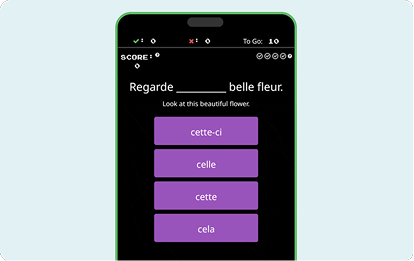
Multiple choice
Play through thousands of sentences to practice your reading skills, expand your vocab, and level up your grammar skills.
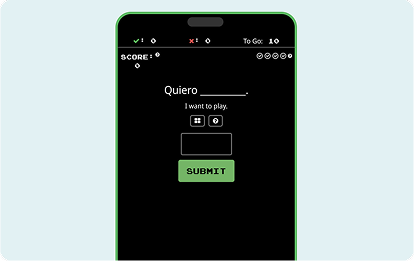
Text input
Put your memory to the test while improving your writing skills. Find out whether you really remember that conjugation or spelling.

Practice listening
Fill in the missing word or sentence based on what you hear, or try the hands-free radio mode, currently in beta on the mobile app.

Best of all language learning apps I’ve tried, and I’ve tried a plenty. With this app, I actually retain the vocabulary and sentence structures I learn, while most other apps that provide a more fun game-like experience end up almost useless for actual learning.
—Pentti S., Google Play
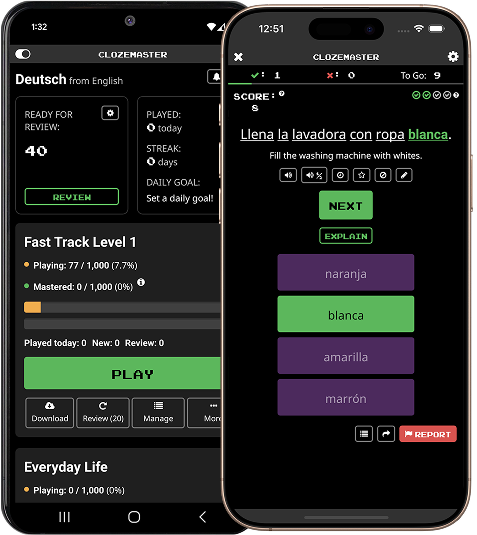
Learn on the go.
Use your downtime to level up.


Get fluent even faster with
Clozemaster Pro

Unlimited play
While a free account lets you play up to 30 sentences each day, a Pro account lets you practice as much as you want.

Unlimited listening
Understand your target language faster with unlimited listening practice in multiple modes for over 30 languages.

Unlimited languages
Maximize your learning potential with access to every language available on Clozemaster, at no extra cost.

Offline mode
Keep learning anytime, anyplace by downloading all of your collections to play offline in the mobile app.
 1-c1c9ae743b32e19cc016d0a8c84189e0070087d17233c96358e58432950e5cc8.svg)
Cloze-Reading
Improve your reading skills by filling in missing words for longer texts. Play Wikipedia articles, or import your own.

Customize to you
Adjust play options for how you learn best, including review intervals and number of sentences per round.